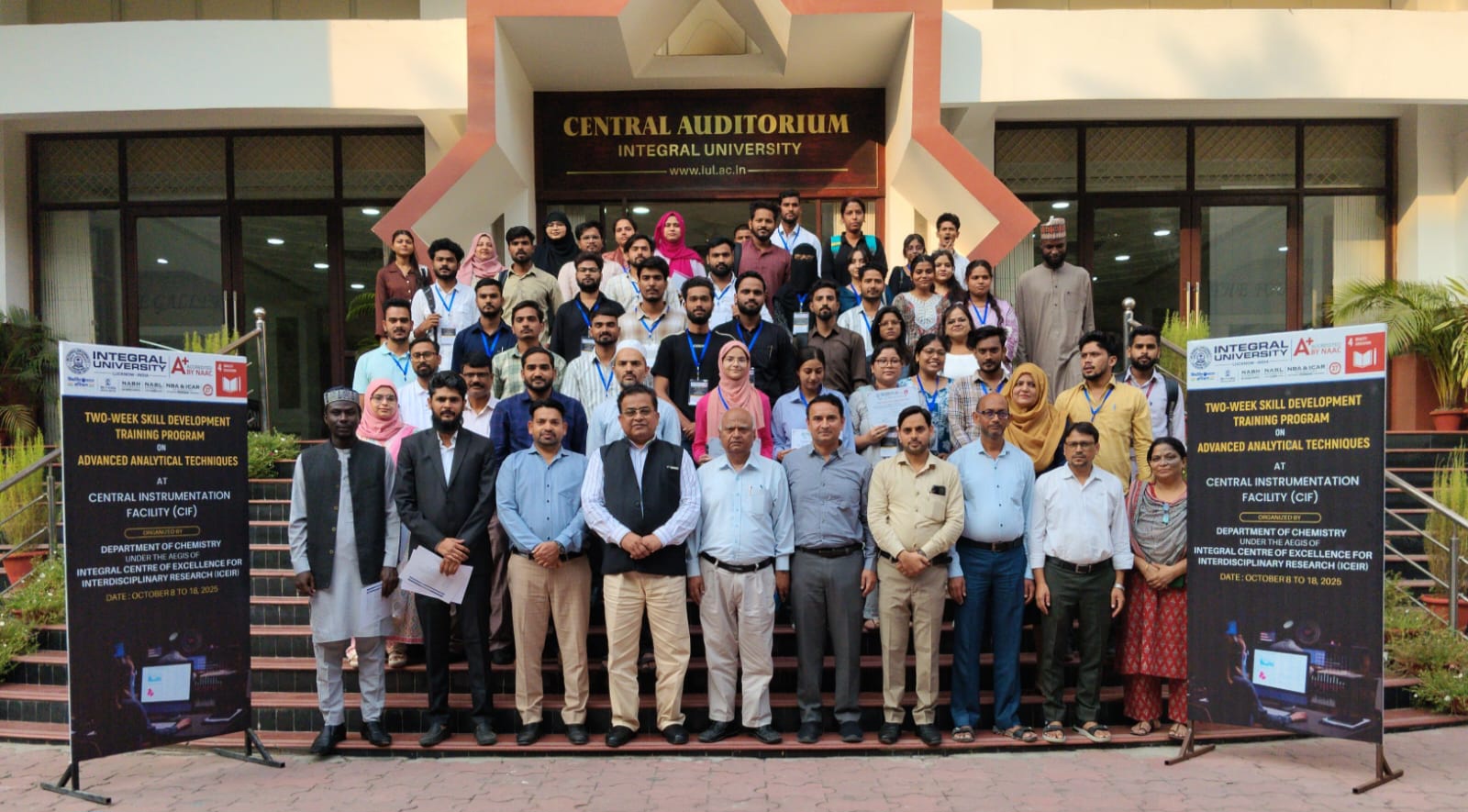
The program commenced with an inaugural session graced by Prof. Abdul Rahman Khan, Dean, Faculty of Science. In his opening remarks, Prof. Khan underscored the visionary leadership of Prof. S. Waseem Akhtar, Founder and Chancellor of Integral University, in fostering academic growth and establishing ICEIR as a hub for interdisciplinary research.
He congratulated the organizing team and emphasized the critical role of advanced analytical tools in scientific innovation and healthcare diagnostics. He further encouraged participants to capitalize on the opportunity to advance their technical acumen and contribute to translational research.
Prof. Wahajul Haq, Director, ICEIR and Dean, Research & Development, commended the Department of Chemistry for promoting interdisciplinary learning through high-impact training initiatives. He highlighted the significance of sophisticated analytical instruments such as ICP-MS, LC-MS/MS, and HPLC in sectors ranging from pharmaceuticals to environmental science and clinical research. Prof. Haq also reaffirmed ICEIR's commitment to supporting such academic endeavors.
The training program featured expert-led sessions and live demonstrations designed to enhance both theoretical understanding and practical skills. Key highlights included:
Dr. Mohammad Shariq provided in-depth training on High-Performance Liquid Chromatography (HPLC), focusing on chromatographic techniques and method validation.
Dr. Zainab Feroz conducted sessions on sample preparation protocols, stressing the importance of meticulous pre-analytical procedures for reliable results.
Dr. Jamal Akhtar Ansari, Program Coordinator, CIF Faculty In-Charge, and Assistant Professor in the Department of Chemistry, led the sessions on Inductively Coupled Plasma Mass Spectrometry (ICP-MS) and Liquid Chromatography–Mass Spectrometry/Mass Spectrometry (LC-MS/MS), showcasing their applications in trace element detection, environmental assessments, and pharmaceutical development.
The program drew enthusiastic participation from undergraduate and postgraduate students, researchers, and professionals across disciplines. Attendees included representatives from renowned institutions such as King George’s Medical University (KGMU), Sanjay Gandhi Postgraduate Institute of Medical Sciences (SGPGI), University of Lucknow, and Integral University.
Participants appreciated the interactive format, real-time demonstrations, and practical problem-solving sessions, which greatly enhanced their technical competence. The training concluded with a formal certificate distribution ceremony and a vote of thanks, marking the successful completion of a highly enriching two-week program.